RuneQuest rules for the monster briefly described in that Hugh Cook’s Chronicles of an Age of darkness Book 1 – The Wizards and the Warriors.
The Lopsloss is derived from Hugh Cook’s book: The Wizards and the Warriors Chapters 13 & 19. In the book it is described as an amorphous creature that lives under Castle Vaunting.
For RuneQuest purposes the lopsloss is distantly related to the head hanger. In its natural state it lives in darkened gulleys and caves, where it can feed on creatures that may fall to their deaths, or stumble within close reach. It can move slowly, but if food is in close proximity, can display a burst of rapid movement to snag its prey. It has an amorphous gelatinous form and is usually greyish in colour. Some specimens have been known to evidence pinpricks of bio luminescence, perhaps to lure [prey to within reach.
The Lopsloss is not a magical creature like its distant relation and feeds on flesh. It does however have similarities, with a tendency to retain the non digestible bits of its prey, such as armour , coin etc. It will feed by enveloping its prey within its gelatinous form and then excreting strong digestive enzymes to break down flesh and bone into a base fluid which it will absorb. These enzymes have the ability to immobilize prey swiftly, but while the prey is still mobile, the Lopsloss will move to suck the prey deeper into its mass to prevent escape. Given enough time, it will digest all organic parts of its prey, including bone, claws etc.
In terms of movement and propagation, it is similar to the amoeba, using pseudo pods to assist with movement and splitting via binary fission. Even so, it is a very rare creature to come across as it does not like daylight and any offspring would have to live within the same cave complex as they would not be able to migrate across land for any distance that may expose them to light.
Small lopsloss have been known to be captured and transplanted to other locales, such as crypts, to guard against grave robbers. In certain instances, goblins have been known to have a symbiotic relationship with lopsloss, whereby in exchange for food and protection, the lopsloss gestates goblin offspring within its mass.
A Lopsloss will vary in SIZ depending on the size of the area it inhabits, age and food availability.
this article was initially published on IX January 2010
Lopsloss
Characteristics
Average
STR
4D6 + 6
20
Move 1
CON
4D6
14
Hit Points 18
SIZ
1D6 + 8 to 6D6 + 20
6 – 7
Fatigue 15
INT
3
3
POW
2D6 + 6
13
DEX
2D6
7
Hit Location
Melee (D20)
Missile (D20)
Points
Pseudopod
*
*
4/8
Body
#
#
4/12
* Determine how many pseudo pods before combat (1D12) and list each as a hit location. # The difference between 20 and number of pseudo pods.
Weapon
SR
Attack %
Damage
Pseudo Lunge
1
40 + 3
2D8 knockdown / entangle
Envelop
10
70 + 10
1D6 per round
Notes: The Lopsloss will use its pseudo pods to try and knock down or entangle its prey in an attempt to immobilise. If more than one pseudo pod manages to hit the same hit location, the prey will be considered entangled. It will then try to envelop its prey at the end of the round. Enveloped prey must match STR against the Lopsloss STR on the resistance table to escape. The Lopsloss does not like heat and will retreat from an open flame or similar, which can be used to force it to disgorge recently enveloped prey. Being enveloped will restrict movement and stop prey from cutting themselves free unless a critical success is rolled or the prey has freed their arms by matching STR on the resistance table. Prey enveloped for more than 2 rounds must try to survive asphyxiation as per standard asphyxiation rules.
Why do elves all look the same? Are they just long living pointy eared humans? This article should explain some of the mysteries around elves.
Warning: Some of the themes in this article may be considered as having mature content. If you do not think you can handle such content, do not read further.
Foreword
Like 99% of Fantasy Role Players, I have read Lord of the Rings. While I appreciate Tolkien’s take on elves and by extension goblins and orcs, I do not believe that can be the only view. Simply put, it is a concern that so many people adhere to the elfin canon created by Tolkien.
You know which one: “Elves are pure, beautiful, long lived etc, while orcs are evil and base creatures.” Then there is the ultimate insult: “Orcs are a degenerate form of elf!”
This treatise describes an alternate take on the canonical picture of elves. It is based on the authors own ideas and dislike of the elves that the classic FRP gamer loves so much.
It does not reflect the views of other members of RuneQuest.orc. I do however hope that it is of some use, even as a discussion point for other players out there. Furthermore, its main focus is that of elfin physiology and as such this cannot be viewed as an exhaustive document of elfin culture.
Elves in Context
What the orcs say: Elves are females! Have you ever seen a male elf? They all carry bows, so they must all be female.
It could be a case of cultures clashing, because only orc females use bows. It is thought of as a feminine weapon by orcs, even being seen to touch one could cause a male orc to be shamed and lose status among his peers.
But there is some merit in what the orcs say. Elves all look the same. Long hair, slim, soft features, sexually ambiguous. Are they hippies, or is there a deeper mystery about them? Has anyone seen one naked?
Note: Where comparisons are made below, unless otherwise specified, such comparisons are based on a human benchmark.
Basic Physiology
Elves are part of the animal kingdom. They tend to have symbiotic relationships with various plant species which has at times caused some to confuse them as being a vegetable based species. They can be divided into various sub species, but generally the views expressed are those of the common or “wood” elf.
While exceptions to the norm do exist, most elves reflect the following traits to various degrees:
Long lived
Tall
Wiry
Androgynous
Herbivorous
Diurnal
Unique class of animal (i.e. not mammals, reptiles etc.)
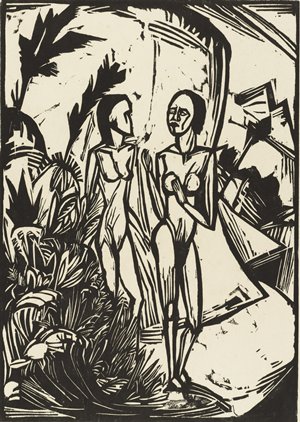
Art by Erich Heckel
The symbiosis they share with their host plants is usually so close that lifespan is tied in with a host plant. Thus if the host plant dies, generally the elves tied to it die as well. This may explain why elves tend to be super protective of the woodlands and forests they live in. It may also serve to explain the longevity of sup species who share mutualistic or commensalistic relationships with long lived tree species. By extension it is thus assumed that a parasitic relationship will be less likely to exist, although such a concept should not be entirely ruled out.
Travel of any large distance from the host plant can be difficult, sometimes impossible for species with very tight symbiotic bonds. This can be alleviated thought certain rituals and matrices which allow for communion with the host via the spirit plain.
Magic
Elves tend to have a natural affinity with spirit magic which is usually ritual in nature. Most rituals are communal. Certain spirit spells ane however readily available to elves who have reached maturity. These spells are usually of an earthy or pastoral nature.
Sorcery is not unknown among elves, but the rules to study and master their sorcerous arts are the same for elf and human. Elves do however have much more time to learn sorcery and build up reserves of magic. Simply put – beware the aging elfin sorcerer!
Elves do not perform divine magic.
Some consider elves to be magic creatures due to their affinity with the spirit plane. This may be true to some degree. It would also mean that while elves may access the spirit world with relative ease, vice versa would also apply. Thus issues that may stem from the spirit plane could be exasperated among elfin kind. Simply put, their sensitivity to the spirit world can make them strong, but it can also cause them to be affected to a greater degree by events on the plane, be the consequences beneficial or dire. See goblins further in this document.
Reproduction
The big question! Why are elves so difficult to tell apart? The answer is simple. One cannot differentiate as they are hermaphrodites. Elves are true hermaphrodites (as opposed to so called human hermaphrodites.) When sexually mature, they are able to breed with any other sexually mature member of their own or similar sub species.
Elves take many years to reach sexual maturity, another aspect that may be linked to their host plant. Once maturity is reached, they undergo periodic fertile cycles. These cycles differ from species to species, but are thought to generally occur every five years. As such it is imperative that members of the same tribe become fertile at the same time. Should a member of another tribe wish to breed for the sake of strengthening the gene pool, it would be imperative that they live among the tribe they wish to breed with for a sufficient period that their fertility cycles may align. (This may also possibly be facilitated via magical means.)
Due to the timing necessary to ensure successful breeding, mating has become highly ritualised. It would appear that emotions (assuming elves experience such) have no place in the mating ritual, but rather that partners are selected in terms of best genetic parings, to strengthen the overall tribal gene pool.
Physical coupling requires some hours to complete. It is thus essential that elves who have coupled are not disturbed, which also speaks to the structure of the mating ritual. The reason that coupling takes so long is that they do not deposit their sperm into each other, like a mammal may. Instead, one elf transfers its egg to its partner. This is done via means of an ovipositor, which enters the others birth canal where it passes over male organs which excrete sperm cells. The sperm must make their way into the opening at the end of the ovipositor and fertilise the egg that by this time would already be making its slow way down the ovipositor. The ovipositor then makes its way further down the birth canal to the womb, where the now fertilised egg is deposited to take root. The ovipositor is subsequently retracted back into its owner.
The ovipositor and birth canal are separate organs and thus allow both coupling elves to deposit eggs into each other during the same coupling if they so choose. Single sided couplings do occur, mostly among sub species with shorter fertility cycles.
When not mating, genitals look like two holes next to each other, the birth canal being the larger. Curious humans have been known to confuse the birth canal with a human vagina and either overlooked the retracted ovipositor or thought it to be a urethral opening. (In fact elves do not have a urethra or kidneys. Their blood waste is excreted via their colon.) Gestation period once again differs among sub species, but is generally accepted to be between 340 and 410 days. Birth occurs via the birth canal and in this way is probably the closest in similarity to that of humans.
Infants are not nursed by their “mother”. Elves do not have mammary glands. They receive sustenance from their sub species host plant. Depending on the sub species, this may be in the form of fruits, leaf sap, or even special sap excreted specifically for the purpose of the plants symbiotic partner. It is at this time that the young elf bonds with its host plant.
Half Elves
Though physically elves may appear to look similar to humans, such similarities are purely superficial. Interbreeding between the two species would not only be impossible at a chromosomal level, but would also be physically impossible. One could appear to put the right bits in the right places, but would indeed not be doing so.
Thus, the reader is asked to cast the idea of a half elf from their mind. They cannot exist by any natural means. If a half elf character is so deeply desired, one would suggest playing a game like Dungeons and Dragons that does not pay attention to the concept of species and chromosomes.
What about the tree?
If elves are so closely bonded with a host plant and gain so much benefit from the plant, what does the plant get in return? It depends on the form of symbiotic relationship that exists between the sub species and the plant:
Mutualism – Both parties benefit each other. This is probably the most common form of symbiosis employed. The tree will in turn for providing shelter, sustenance and a physiological bond receive protection, sustenance (compost) and propagation. In extreme cases, the tree may be unable to survive or propagate without its elfin partner.
Commensalism – One party benefits, the other party is not harmed. The elf receives the same as per mutualism, but does not give anything substantial back to the host plant. Less common, but leads to a looser bond with the host, allowing the elf to travel from its host, or even change hosts.
Parasitism – One party benefits to the detriment of the other. Very unlikely and as such longevity associated with the tree would not be possible and would indeed be detrimental to the elf’s lifespan should a elf/tree bond exist. Alternately, if no such bond existed, associated elfin lifespan would be intermediate, probably similar to that of a human.
Orcs
Orcs are in no way related to elves. Case closed! If you wish to insult an orc, insinuate that he has elf blood. You will succeed, you will also likely die shortly thereafter. If anything, orcs are probably closest likened to humans, but share a very dissimilar ancestral tree and do not derive from simians. They are however mammalian in a very broad sense. And no, you do not get half orcs.
Goblins
Goblins on the other hand are distantly related to elves, although one will never hear an elf confirm this. When reference is made to “a degenerate form of el” it is with goblins in mind. How these base creatures came to be is debatable, but various hypothesises have them as being the result of, inter alia, some bizarre failed experiment, inbreeding of an isolated elf community, corrupted and warped by diabolic spirit magics, cursed by the gods etc. Some people believe they exist as a result of some or all of the above!
Goblins are small, scrawny creatures with a tendency to steal anything they can carry or lead away. They are not very bright having intellect similar to that of a rat insofar they have a capacity to learn, but can also pass on some crude learning’s to their family. Family is used here in a broad sense, as a goblin tribe is usually very much related.
Why goblins are considered dangerous and highly undesirable is not through individual encounters, which are bad enough as they carry disease and are generally a nuisance. The main problem with goblins is that they breed fast and profusely and if they are allowed to establish a nest, a few nuisance goblins will become a menacing, ravenous hoard in the space of a season. What they lack in individual strength and stature, they make up for in numbers.
Goblins are fortunately the opposite of their elfin ancestors in terms of longevity, leading short, violent lives. Those that do survive to old age may count perhaps four years before their body wears itself out. Their scrawny bodies are barely sufficient to sustain themselves, let alone offspring. In terms of reproduction they have taken a symbiotic leaf from their ancestors book.
Within a goblin nest (usually a warren of caves), a large chamber is excavated. Within this chamber is a creature called a Lopsloss. The Lopsloss is related to a head hanger, but has long since lost the ability to move. It relies on its symbiotic goblin partners for sustenance, protection and propagation:
Sustenance is provided by the goblins in terms of any flesh they can feed the Lopsloss, flesh or carrion, it digests it all.
Protection is provided deep within the goblin warren, were the goblins will fight to the death to protect their Lopsloss.
When groups of goblins split off to establish new colonies, they take a portion of Lopsloss with. As the Lopsloss propagates by binary fission a new one will soon grow in the new colony.
In return, the goblins receive a valuable service from the lopsloss. It gestates their offspring. Goblins become fertile often, every season it is thought. When they mate, they follow a similar procedure to elves, but are no longer in possession of wombs (which have become superfluous and desiccated ove many generations of non use.) Instead, the egg, once fertilised, is deposited into the lopsloss.
The fertilised egg is somehow recognised by the lopsloss and in return for sustenance, it converts proteins and secretes nourishing fluids that help the goblin embryo grow. If however the lopsloss begins to starve, it will digest the embryos. This is why as a last resort, goblins will immolate themselves to feed the lopsloss and save their offspring, if such an event comes to pass.
Due to their nature and the way they are sustained as embryos, goblins are carnivorous.
Gæa is our groups home grown world. The name is hardly original, but it works. Gæa started out as a continent which one of our players (Carol) drew up when our RQ group got back together after a long role playing drought. Using Coral Draw, she took the outline of Germany, reversed the image and transposed mountains, rivers, borders, country names and the like onto it. It was a bit of a rush job, but Carol is very talented, so even her rush job looked great and had a nice fantasy feel to it.
Some of the country names were straight out of novels (Drasnia – The Belgeraid, by David Eddings) and real life places. (Faerie Glen is actually a suburb of Pretoria, South Africa – really cool name for a fantasy place as well). It was a lovely setting and we quickly notched up numerous adventures there. As time went by, we replaced plagiarized names – Drasnia became Dalatia etc. Many unnamed features were fleshed out, the huge mountain range in the North became the Northice Mountains and we even found a place far to the south to situate Elderad, The Lost City (A RuneQuest module).
I am never content with what is available. I needed a place for my favorite creatures, Lizard Men. So some more continents and islands sprung up, Araktor, Vasniss, The Misty Isles, The Tinn Isles, Illium Cromia to mention but a few.
Gæa retained its name but we needed to name the world, so we ended up with a continent of Gaia on the world of Gæa. Maps were drawn and re drawn (by hand, with MS Paint, Campaign Cartographer (free demo) and eventually Autorealm, a shareware package which is written in Delphi).
The original Coral Draw map of Gaia was lost during a PC rebuild, but we still have the paper printout. Histories were written, gods dreamed up and this process still continues.
As existing material is rehashed to make sure its fits and new material is written, it will be published here. The maps will be redone again before they are published as some basic rules of geography and cartography were broken and need to be remedied. (E.G.: There are way too many jungle areas at latitudes which should not warrant that sort of vegetation.)
As always, criticisms and comments are welcome. Even if you pick up something like a name or concept which appears to be the work of someone else, let us know. We have read so many books and played so many games that sometimes ideas and names which we consider original are far from it! As such, we would hate to be thought of as pinching other peoples ideas and/or work.
Also encountered as Bazzats Best Bezzle, Bazzats Bilious Beer, Bazzats Berserk Barrel, and Bazzats Bitter Bevvy
Rare POT 2d12 (per barrel)
History: Bazzat was an infamous orcish brew master. It is reasonable common knowledge that orcish beer can make guzzlers do some strange things. Most orcish beer differs greatly from barrel to barrel, depending what ingredients were available to the brewer at the time of brewing. Bazzat was an orc of exceptional intelligence. While experimenting on new brews, he stumbled across a recipe, which contained certain herbs known to have magical properties, which was to become his masterpiece. A beer that would make the drinker invincible. He committed this recipe to memory.
Unfortunately, orcish brewing techniques being what they are, the recipe was not always duplicated exactly, resulting in some interesting side effects. The net results was that Bazzat was beaten to death by an enraged chieftain, after his army of veterans was forced to join battle sick from one of Bazzats kegs and were subsequently slaughtered. The recipe supposedly dies with him although his apprentices often tired to duplicate it. Kegs of Bazzats original brews are still to be found and drunk, if one dares.
Description: Imbibers of Bazzats Battle Brew must resist their CON vs. the brews POT, per mug quaffed. (The brew being active). A successful resist will allow the drinker to roll on the success table below. A critical success (01) will result in the imbiber going berserk. (The original brew resulted in an immediate berserk rage, but the process was never duplicated). A failure to resist will allow imbiber to roll on the failure table below. A critical fumble (00) will result in the imbiber dropping dead on the spot. (Subject to standard divine intervention rules, nyar nyar snigger.)
Note: Imbibers should resist once for every mug quaffed and roll on one of the below tables for every mug, bar for critical successes or fumbles. The brew takes up to an hour before any effects are felt.
Success Table
D100
RESULT
Critical (01)
Berserk rage. *
02 – 10
Attack fury, +10 to primary weapon attack %, -5 to primary weapon/shield parry %. Effect lasts for 1 hour.
11 – 18
Thick skin, +3 to AP in all areas, -2 to MR. Effect lasts for 1 hour.
19 – 27
Feel great but still drunk, +5 to global HP, -5% to dodge. HP bonus stays, Effect to dodge wears off in 2 hours.
28 – 40
Alert, +10 to current fatigue. Will sleep for 5 hours once effects wear off (1d4 hours).
41 – 55
Projectile vomit, enemies within melee range must dodge or take 1d4 damage from acid vomit. Unable to use weapons while vomiting. Will vomit 1d6 times.
56 – 70
Clever tongue, able to throw the best insults and demoralise opponents. (Use current fast talk +35%) Demoralised foes will only attack once every second round – effects not cumulative. A fumbled roll will demoralise the imbibers comrades. Brews effects last 1 hour.
71 – 85
Animal instincts, weapon attacks are forgotten. Attack with fists, feet, head and claws and teeth. All natural attacks at +20%. No shield or weapon parry. Effects last 1 hour.
86 – 90
Fast man, brew lends super speed. Moves at twice normal MR and attacks at twice normal attack %. Damage is halved. (Divide damage by 2). Effects last ½ hour.
91 – 95
Blind rage, lash out blindly at friend or foe. Double his primary weapon attack and double normal damage.
96 – 99
Strong man, become super strong. All damage is doubled, but actions slowed. Attack, move and parry at ½ normal rate.
00
Uncontrollable drunkenness, this confused state will have the imbiber stumbling around in battle. All rolls to be made at ¼ normal %. A hit, which draws blood, will shake the imbiber from his stupor. Re roll on table if this happens. 04 – 02 Sleepy, must resist CON vs. Brews POT every turn or fall into a deep sleep for 1d6 hours.
Failure Table
D100
RESULT
Fumble (00)
Instant death.
99 – 80
Too sick to fight, all rolls at ½ normal %.
79 – 70
Really sick, vomit over self. Take 1d4 points damage per area vomited on (missile hit location table), vomit 1d6 times.
69 – 60
Dodgy aphrodisiac, really attracted to nearest orc (or human if drinker is orc).
59 – 45
Poisoned, lose 1d8 global hit points.
44-35
Feet will not respond to commands, imbiber can only move by shuffling around on knees and must fight from that position (use standard rules for fighting from the ground).
34 – 25
Unbearably weak, loose 1d12 fatigue points and STR halved. Check STR limits to weapon use. Effect wears off in 1 hour.
24 – 20
Vision blurred, cannot see to attack or parry properly. All attack/parry rolls at – 10 and 50% chance of attacking comrades.
19 – 15
19 – 15 Clumsy, continually drop items of equipment/trip over own feet.
14 – 10
Battle master, imbiber thinks he/she is the greatest warrior ever. Will insult comrades and try to direct the battle. Good chance of being stuck in the back by an offended comrade.
09 – 05
Endo parasite, something was living in the mug you just quaffed. This parasite will slowly whittle away at its victims health, eating him from inside. Loose 2 global HP immediately and 1 per day thereafter. Also loose 1 point of CON per week or part thereof until victim dies or parasite removed.
04 – 02
Sleepy, must resist CON vs. Brews POT every turn or fall into a deep sleep for 1d6 hours.
01
Battle lust, all attacks at +20 no parry allowed. Drinker will be stuck in a battle rage and will attack anything moving, friend or foe until effect wears off (1 hour) or he is subdued and calmed down by his comrades (Rolled in snow, water thrown over him etc).
GMs Note: Please modify this table as it suits you. It is designed specifically for orc and human drinkers, so feel free to make changes for other species.
Guarantee: Bazzats Battle Brew is guaranteed to make the imbiber drunk and result in a raging hangover.
Caution: Beware of imitations, such and Danukz Deadly Dram and Gurdoks Grotesque Grog. Be specifically weary of Nimgos Nefarious Nectar – even cave trolls have thought twice before guzzling this baleful booze. Quaffers of Bazzats beer should also be aware of the healing properties of Brodoc Brothers Bottled Black Bull ™.
This article was originally published on XII August XXII
Blend 1 Point Touch, Temporal, Nonstackable, Reusable Common
This camouflages a person or an object by blending in with another object it is placed against. So a person blending in with a tree trunk to appear to the viewer to be part of the tree trunk.
The affected party must be touching the item it is blending with and the total SIZ points of the affected party must be less than those of the item it is blending with.
Multiple items of different appearances or textures cannot be blended with, , however one can blend with sand or pebbles on a beach or bark on a tress trunk. Blending does not make one invisible.
Where the affected party remains motionless, treat Blend as a special success Hide or Conceal roll. A successful Hide or Conceal roll in conjunction with Blend spell will be the equivalent of a critical success.
Moving will not break the spell, but will allow any person searching or looking at the affected party a better chance to see them. I.E. Moving will reduce the affects special affect of Hide or Conceal to a normal success.
Thanks to Leon Kirshtein and Stephen Posey of the RQ Rules List for their contribution to this spell.
These are not your regular razor shells that are often fished for in the sea bed and make a tasty shellfish treat, but a rather more sinister variety.
In the desolate wastes of a dried up sea bed lurk the razor shells. These are close descendants of the more mundane razor shells found under the seas sands, but have been forced to evolve as their habitat dried up.
The shells still eke out an existence beneath the harsh wastelands of the dry seabed and have managed to do so via some remarkable adaptations. Their original cylindrical, cut throat razor, shaped bodies have grown longer. The bottom most section which is deepest in the sand sports long barbs, which help anchor it in place, but still allow it to burrow forward (downwards). A denser and harder shell protects the organism from heat and water loss, allowing it to go for long periods without water, while also providing internal pockets wherein moisture can be stored in times of rain.
Its most remarkable and devious adaptation however is the means whereby the shell is able to sustain itself. Where its ancestor filtered the water for tiny organisms, no such contemporary nourishment now exists. Instead the shell has had to become a devious ambush predator. The upward facing portion of its body has developed a barbed harpoon tongue of razor sharp hard mother of pearl. This harpoon is held inside the shell waiting for pressure from above, the Razor Shell having positioned its top end just below the ground level. When sufficient pressure is applied, coiled muscles shoot the harpoon upward. This action is similar to that employed in the nematocyst of the hydra polyp or jellyfishes stingers.
The razor is not as subtle in subduing its prey as a jellyfish however as it has no poison. Instead it relies on the devastating damage its harpoon does as it pierces its preys flesh. This is where the Razors length and anchoring barbs, as well as its extremely strong muscles, play their role.
The part of the shells body that is attached to the harpoon can stretch to double its normal length. With the harpoon anchored in place, its prey is unable to escape and eventually succumbs to exhaustion, blood loss and shock. This does not mean that the Razor Shell waits for its prey to die; indeed thin feeding tubes extend through a small hollow at the tip of the harpoon and start to dissolve and devour the preys living flesh moments after the harpoon strikes.
While Razor Shells can grow up to a meter long and project harpoons that could be lethal to larger animals, their primary prey is smaller animals. However they do not appear to be able to distinguish potential preys SIZ and often cause a nuisance as they lacerate feet or damage horses inner hooves and cause lameness. Most shells encountered are a more manageable size of roughly thirty centimetres, although there are always travellers’ tales of monstrously sized shells that have skewered horses from beneath the ground.
Razor Shell
Characteristics
Average
STR
2D6
(6D6)*
Move 1
CON
2D6
7-10
Hit Points 10
SIZ
1D6 + 2
5-6
Fatigue 19
INT
2
3
POW
1D6 + 4
8-9
DEX
1D6
4
Hit Location
Melee (D20)
Missile (D20)
Points
Lower Shell
01-05
01-02
6/4
Upper Shell
06-18
03-19
6/4
Harpoon Tongue
19-20
20
6/5
Weapon
SR
Attack %
Damage
Harpoon
1
75+10
1D4 + 2 (1D4)#
Note: The shell lies in wait just below ground level and will shoot its harpoon directly upwards as soon as it perceives pressure from above. As such it has a very high probability to hit. Due to its position in the ground it will only be able to strike the lower limbs of large prey, whereas small prey can be struck in most logical hit locations.
# Damage is always impale damage. Treat as a regular impale but also note an additional 1D4 damage per round that the harpoon remains in the wound where the Razor Shell still lives and starts digesting its prey.
* The higher STR score is to represent the shell anchoring itself in the ground should its victim try to match STR on the resistance table in order to pull the shell from its burrow.
A guest article submitted by a RuneQuest Lister – Bjorn Are Stolen
The sourcebook Genertela must be one of the ultimate teasers ever published in the RPG milieu. It is stuffed with intriguing notes on cultures, people, history and places of interest. These notes were never complete sourcebooks as we know them in other RPG’s (like Warhammer) though. So the box set made people wait in excitement for the books covering parts of Genertela in detail. -They had to wait for 12 years…
What I have done, and what I guess others have done, is to “develop” regions on their own, based on the few notes given in the official books. What I plan to do on this site is to share some of those regions that I have “developed”, so others can use it if they want to. There are types of regions that I’m going to avoid; those developed by Avalon Hill (Dorastor, Dagori, Inkarth and the Zola Fel Valley), and the blank lands. There might be a miracle; Jesus might turn up and become a Heavy Metal Vocalist, Ariel Sharon and Arafat could start a RPG club and make peace in the Middle East, and new sourcebooks might be published for Genertela. In that case things I have made should of course yield.
Then we have the grey zones; very good material published in Tales of the Reaching Moon”magazines (the Palmatelan Praxian and Sartari regions), and some of the stuff made by Etyries and Issaries inc. I really like the stuff they’ve written, and I think I should buy the Lunar Empire sourcebooks and see if they can be used in a traditional Glorantha setting before making anything for the Dara Happa region myself. (I am optimistic, and think they will be worth buying.)
When I carve out settings in Genertela, I some times alter the geography a bit, and with good conscience. I think the maps in the original RQ publications were intentionally made not to fit each other for two reasons:
To simulate the Genertelan population’s ability to make accurate maps (maybe also because of the influence magic’s have on the world).
So that GM’s could make the geography fit into their settings; to avoid any curriculum.
You can feel free to choose how your geography should be like in my settings if you don’t like my altering of the Genertelan geography.
I have made settings in two Blank Lands; Retrint in Fronela and Balazar east of Peloria, and if someone is interested, I could share them, but I will stick to my principle that the Blank Lands are for any GM to decide what is.
My next article will cover a small area along the southern shores west of Corflu. The name of the setting is “Skoddeheimen” (Norwegian for “home of the fog”).
This article was originally publishedon X October MMII
Very powerful artifacts which can be interesting and deadly. Very rare. POT 14, Charges 1D4
History: Salgrin was a powerful alchemist whose enchanted artefacts became legendary in his own time. Perhaps some of the most bizarre items he created were his transmuting snakes. Due to their dangerous nature, not many were demanded and all record of how many he actually created has long since been lost in the mists of time.
Description: The snakes appear as a highly ornate golden arm torque, made of two snakes loosely intertwined so that a head appears at each end. The torque is about 15 centimetres in length and gives the appearance of the snakes coiling around the upper arm. The snakes are relatively lose, allowing the torque to be bent to fit anything form a SIZ 5 to a SIZ 18 arm. When properly fitted, the fangs of each head will push against the skin near the elbow and shoulder. The eyes in each head can be of ruby, emerald or sapphire – they will not be mixed, i.e. if one head has ruby eyes, so will the other. (See below). Snakes with other kind of gems as eyes have been rumoured to exist, but whether these rumours are true and what effect the snake has is unknown.
Usage: The snakes are a combination of the fine craft, alchemy and powerful enchantments. Normally they appear as an item of exquisite jewellery, but when worn, they quickly change. To be activated, the torque must be worn in such a manner that most of its inner side is in contact with skin, the fangs must specifically be touching flesh. Wearing the torque over armour or in such a manner that it is not tight against the flesh will not activate it
When donned, the torque will remain inactive for up to an hour, after which the snakes will appear to come alive. The first sign of their activation will be that they constrict the arm coiling so tight that the wearer will be unable to remove them. Once this has occurred, causing the veins to rise under the skin, needles protrude from the fangs, easily penetrating the skin and injecting the alchemist’s toxin into the bloodstream. Once this process complete, the needles will retract and the snakes will loosen their grip, returning to their inanimate state.
The toxin has a POT of 14 and must be resisted like a poison. Should the wearer fail his or her resistance roll, the toxin will poison them as per the Rune Quest poison rules. (I.E. 14 points of damage to global hit points). Should the character successfully resist the following effects will occur, depending on what type of snake “bit” them.
Ruby Eyes: STR enhanced by 1D3. Side Effect: As the alchemists brew burns its way through their veins, the character convulses and is overtaken by an unbearable pain and nausea. They may pass out and or vomit as the potent brew warps their muscles. Resist vs. POT again and if roll fails, loose 1 CON point. The character will also have his/her fatigue points reduced to 1 and must rest up o recover from the ordeal. (Remember to adjust stats to reflect new STR). This process is instantaneous.
Emerald Eyes: Shapechange into a Lizard Man. (Use Shapechange Sorcery Rules). Side Effect: As the alchemists brew burns its way through their veins, the character convulses and is overtaken by an unbearable pain and nausea. They may pass out and or vomit as the potent brew warps their very being and scales push through their skin. Resist vs. POT again and if roll fails, loose 1 CON point. The character will also have his/her fatigue points reduced to 1 and must rest up o recover from the ordeal. (Remember to adjust stats to reflect new STR). this process may take a few hours to run its course. Note: One of the strongest rumours evidencing other types of snake revolves around one with jade eyes that turned someone into a dragon or ogre, depending on who tells the story.
Sapphire Eyes: Stone skin. Increase characters hit points in each hit location by 1 point. Global hit points do not change. The characters skin becomes leathery to form a type of natural armour. This process takes up to a week to complete. Side Effects: As the effect of this snake is more gradual, most of the severe side effects associated with the other two snakes are avoided. Characters may feel nausea and temporarily loose up to 1D6 Hit Points. Once the process is complete however, the characters Fatigue pints will be reduced by 1D4 to reflect the extra weight they now carry around. Any tight fitting clothes and armour would also have to be replaced or adjusted.
Note: Other snakes may well exist, their effects beneficial or deadly, on GM’s discretion. No one has been able to replicate Salgrin’s potent brews although many have tried, with sometimes disastrous results. Thus, when the charges on a snake are finished, they are finished for good. What is left is a nice piece of ornamental jewellers which occasionally “bites” the wearer. A critical success Devise roll will allow an appraiser to access the cavity in which the potions were kept.
This article was first published on XIII July MMII
This is one of the oldest articles from this sites origina incarnation published. While it had received small edits in subsequent years, it is presented here, in the state of its last version, circa I October MMVI, for posterity.
Please read the History of RuneQuest for a far more accurate account of the games history.
RuneQuest is a role playing game designed primarily for play in an “ancient” setting, such as Europe was in the days when the Rome was just a city state and Alexander the Great was busy conquering Asia Minor.
RuneQuest Third Edition (Deluxe) – Avalon Hill
The game had its heyday during the 1980’s. In its time, many considered it to be one of the best role playing systems and Glorantha (The RQ fantasy world at the time) was considered to be the best, most detailed and fascinating world available.
Different editions have been published by various companies, but the most recent (and well known), is the third edition, published by Avalon Hill. Although this edition is now out of print, some shops still have copies of the game and its supplements in stock. The third edition is also the only edition we have ever played, so unfortunately we are not in a position to comment on the previous two editions (which many have said to have been very good).
The main game came in the form of a Basic Boxed Set or a Deluxe Boxed Set. In later printings, the Deluxe Box was reworked as a book. Several supplements came out in the forms of adventures and boxed sets. Many of these were dedicated to the world of Glorantha. Herewith a list of RQ products. (I have worked from memory, so if I left anything out, please e-mail me and I will add it.)
RQ Basic Box Sufficient rules to wet your appetite but not enough to get any real role-playing done.
RQ Deluxe Box / Book All the rules, if you want to play Rune Quest, buy this box. The Deluxe box is probably a better buy because the information inside is split into 5 booklets, which allows for use by more people at the same time. You also get dice and a map of ancient Europe with the box.
RQ Players and GM’s Boxes The Deluxe Box split in two. Why, we don’t know! You have to won both if you intend to play, so rather get the Deluxe Box, it will work out cheaper in the end.
Vikings Box (Earth) One of the best supplements, lots of information on Viking culture, some new monsters and magic, well worth the money.
Land of Ninja Box (Earth) For adventures in Japan, or so we believe.
Glorantha Box Pretty impressive. Detailed look at Generatala and what Glorantha is all about although leaves one wondering if Avalon Hill ever planned to cover other continents.
Gods of Glorantha Box Contains inter alia a book listing all/most the gods of the Glorantha and more importantly a cults book which gives more detail about many of the important gods, cult spells etc. If you plan to play a priest,the book is invaluable. Even if not playing on Glorantha, certain cult spells can be associated with your own adventure world deities.
Elder Secrets Box More information on Glorantha. Quite entertaining except for the poor artwork.
Trollpack Box In Tony’s opinion, the best of all supplements. goes into great detail about trolls, what they are like, their history, culture and much much more. Especially liked the Thunderbreath Gobbleguts menu. Make mine a plate of batter fried pixies please.
Troll Gods Box After buying the Trollpack, the Troll Gods will be a disappointment. Poorly compiled, poor art and more than a few unforgivable errors – as in text just stops half way through a sentence and doesn’t pick up anywhere else. Still, has lots of details on Troll Gods, so can be of use.
Monster Coliseum Box Has plenty of pre rolled adversaries, so can be of some use. Probably the best feature was the chariot history and charioteer occupations. Also has a nice floor map of a coliseum.
Griffin Island A boxed campaign. It is still in transit so no further comment available at this time.
Eldorad – The Lost City (RQ Gateway) Nice maps, decent art but we didn’t really enjoy playing it. Will have to give it a second chance someday.
Daughter of Darkness (RQ Gateway) Adventures and plots on a random peninsular. There could be valuable material here, but the names of some characters sound silly.
Apple Lane Module (Glorantha0 Some nice adventures, and interesting people. Haven’t played it but it looks like it could be good.
Snake Pipe Hollow Module (Glorantha) We think that Snakepipe hollow forms part of a trilogy (With Haunted Ruins and Troll Realms). More information will be forthcoming once we own it.
Into the Troll Realms Module Adventures in the troll realms. Bought this in 1996 and still haven’t played it. looks very entertaining though.
The Haunted Ruins Module Further adventures in the troll realms. Looks like it could be very entertaining. Nice art.
Sun County – Prax Campaign (Glorantha The first of the Prax campaign books. Very impressive with plenty adventure potential and nice artwork.
Strangers in Prax Module (Glorantha) Assumable the follow-up to Sun County.
Shadows on the Borderland (Glorantha) Another comparing journal set in or nearby Prax. Impressive artwork.
River of Cradles (Glorantha) The last and apparently the best of the Prax campaign books.
Dorastor – Land of Doom Campaign (Glorantha) Dorastor is a dangerous place full of nasties. If you want to mete swift death out to foolish parties, send them to Dorastor. Very useful and decent art.
Lords of Terror Campaign (Glorantha) We think this is a book of chaos cults.
Glorantha Bestiary (Glorantha) Lots of new monsters endemic to Glorantha. Also has a small section attempting to make Basic RQ more playable by providing Deluxe RQ information such as additional magic spells etc. Nice art and some really weird monsters.
RQ Cities We know little of this although rumor has it that it is a RQ Badged version of Midkemia Cities.
Adventure Sheets – Human No, Tony is not gullible. Just attempting to own the entire Avalon Hill Rune Quest collection. Unfortunately that means buying unnessiary, money making scheme items, like pre printed adventure sheets. At least, when looking at the numbers on the sides of the boxes, all will be there.
Adventure Sheets – Non-Human As above.
GLORANTHA is now a separate game, published by ISSARIUS INC.
AVALON HILL was bought by HASBRO INC during 1999. To date there has been little news as to whether Hasbro intends to publish further RuneQuest items or to sell the game rights to another company. Word through the grapevine has RuneQuest being managed by Wizards of the Coast, a Hasbro subsidiary.
Updated I October MMVI MONGOOSE PUBLISHING has been licenced to publish a new version of RuneQuest, which includes Gloranthan material. This new version deviates somewhat from previous versions in terms of rules. Alternately known as RQIV and MRQ, only time will tell if it is successful.
Possibly the original book depicting orcs as the main protagonists, Grunts! by Mary Gentle first saw publication in 1992. I am not one to make a habit out of re-reading books, yet this is one of the few exceptions I have made. Simply put Grunts! Is a very fun book to read!
Without giving too much away, the story starts off as pretty much standard old school high fantasy cannon. The Dark Lord is gathering his forces for the Final Battle. It is at this time that we meet band leader Ashnak of the fighting Agaku. Let us just say shortly thereafter things go pear shaped and then the story takes a sharp left and heads off into non High Fantasy territory. All in all an entertaining read that I can recommend to anyone looking for something a bit different.
But that’s not the whole point of this post. I am sure far more qualified people have reviewed this excellent book since its publication.
For me the most exciting thing about Grunts! (over and above the great read) was that it depicted orcs as the heroes. Well lead protagonists or maybe anti heroes if you like. It gave one a glimpse into what orcs could be about and came up with a bit of a standard for orcish names. Marukka, Dakashnit, Razitshakra etc all found their names used as time went by when I was Game Master in our local RuneQuest group. Suddenly orcs had names and eventually, after much winging on my side, the other core GM (Willo) caved and allowed me to play an orc. But that’s a topic for a future blog.
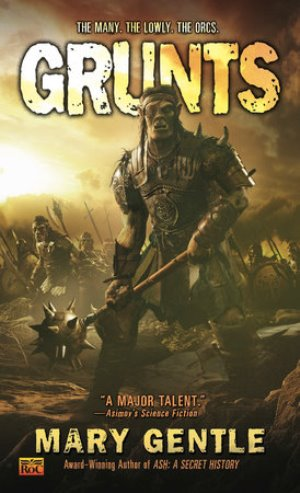
Roc cover by Romas
I think the key contribution Mary Gentle made by publishing Grunts! was to prove it could be done. There were punters out there eager for this type of novel. We were not out looking for a treatise explaining how orcs were misunderstood gentle creatures, but wanted to see them in all their violent glory, something Mary Gentle achieved.
So if you have not read Grunts! Yet, go out and get it. From what I can see on the net it has been republished, so it should be easily available.
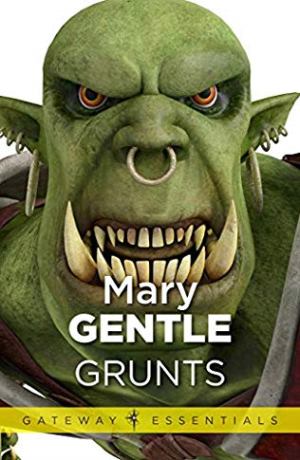
Roc/New American library cover.
For those willing to search about for old magazines, look for Orcs Drift by the same author. This is a sort story that was published in the old Valkyrie RPG Magazine (Volume 1, Issue 3 of 1994). It also saw publication on in Odyssey Magazine Volume 0, 1997 as well as the authors Cartomancy collection which was published in 2004.
This article was originally published XXVII April MMXII