Adventures in the Northland

1       Introduction

This adventure was conceived as a fast one nightery to allow a dispersed group of players who cannot get together often to have a fun time without an adventure taking more than 8 hours, with a possible allowance for a few more hours if so desired.

It assumes the party of characters will now each other. Great for an established party but if new characters are being introduced, it requires a degree of preparation form the players, even if a mild bit of prologue play can be arranged among the players who can meet up beforehand or attempt the same online.

The ruleset to be used will be RuneQuest 6th Edition aka Mythos although the design should be open enough to use many other RuneQuest versions or other systems, the latter with a little porting.

Due to the time limitations in creating as well as running this adventure a certain level Designers Fiat is required inasmuch as the characters are expected to all be gathered in a single location and have some connection to each other. i.e. The party is already together, to save time in introductions and finding reasons to be where they are and motivations as to why they would go off on what could be a dangerous adventure. The initial plot hook, spoken by a travelling storyteller should also be taken as a good enough reason to head off on the adventure, without having to resort to complex motivations, gatecrashing dwarves or the like.

In terms of overall design, the adventure leans on some recognisable folklore stories. Time was also limited in creating this adventure, so a few items have been borrowed from the excellent Paths Peculiar website. Only links are presented here so the hope is that this is seen as promotion of Paths Peculiar while working within the artists request not to reproduce his art without permission.

The adventure is based on our homebrew world of Gæa which some of the players who this ad hoc adventure was created for have been playing in one form or another, on an ever-changing map, since the mid 1990’s. The setting is designed to be somewhat equivocal so should easily port into one’s own world if so desired.

On a parting note, as our homebrew world developed and grew from a single smallish continent to what is briefly presented herein, some names stuck. We thought it was humorous, albeit not so imaginative, to have a world called Gæa while the original continent – always called Gaia kept its name. If you like what you see check out the rest of RuneQuest.orc for some ideas, maybe you will like the world enough to say for a while.

2       The Continent of Gaia

Gaia is a massive continent that stretches from The World of Gæa’s arctic circle to straddle the equator in its most southern reaches. The figure below shows the world naming the continents of Gaia, Araktor and Vasniss:
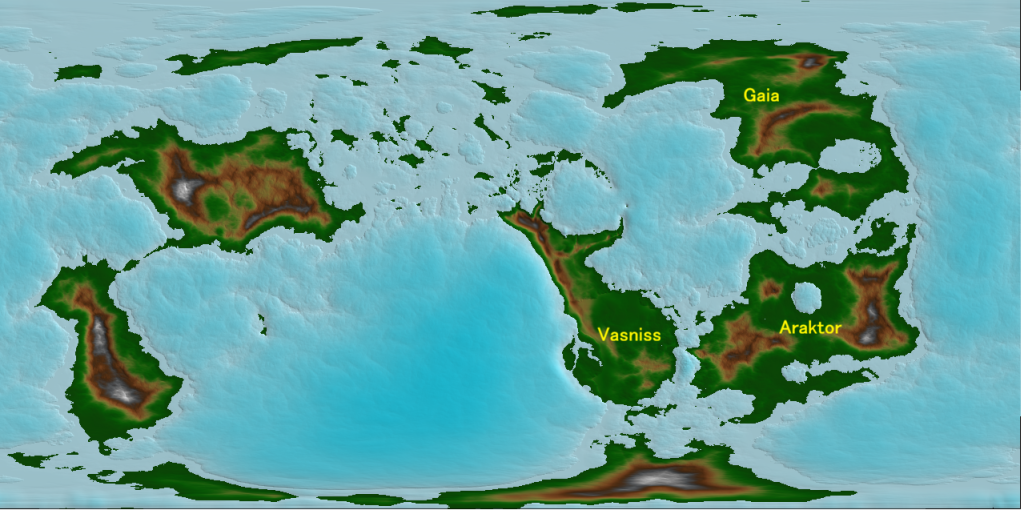
Gaia along with Araktor are the dominant landmasses of the Eastern Hemisphere assuming a Meridian dropping through the western reaches of Vasniss. Gaia itself may be split into three main regions:

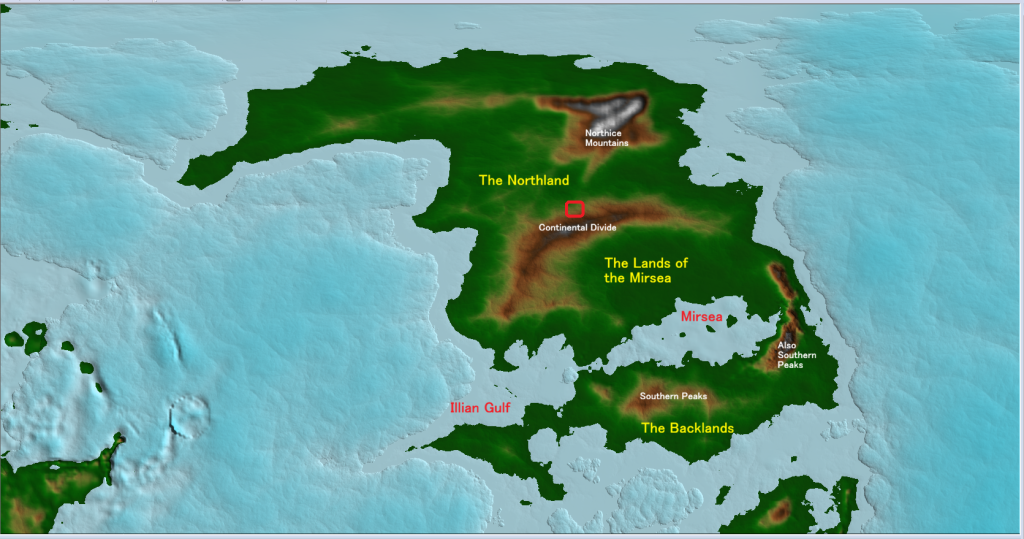
  • The Northland. A formidable mountain range splits Gaia into two near equal parts. Everything north of this range is generally considered The Northland, a rugged dangerous expanse where few not from there dare to venture. Little is known of this land, its geography or its population dynamics. It should be noted that even the portions of this land that extend south, along the western reaches of Gaia are considered as part of The Northland as they are the other side of the mountains.
  • The Lands of the Mirsea – Central Gaia. The Mirsea comes close to splitting Gaia in two. All the lands surrounding the bowl which is centred on the Mirsea stretching from the continental dividing mountains in the north to the Southern Peaks south of the Mirsea are encompassed here. The coastal regions of the Illian Gulf linking the Mirsea to the ocean beyond are nominally part of this area with no clear border that signifies the start of the portion of The Northlands that stretches down following the sourthern sweep of the mountains. These are considered the most populous and civilised lands by human reckoning.
  • The Backlands. This area encompasses the lands south and east of the Southern Peaks as well as the peninsula jutting out along the southern side of Illian Gulf. More a place of occasional coastal city states interspersed between vast tracts of forest and jungle, this land has a sparse population compared to the Lands of the Mirsea. Certain city states are extremely powerful and wealthy in their own right as they serve as trade hubs between Araktor and Gaia and even the Dark Continent of Vasniss.

The map below shows Gaia indicating the regions discussed:
For context, consider that The Earth is about 2/3 the size of the World of Gæa. Now consider the distance from Svalbard (arctic island holdings of Norway) to Equatorial Congo in Africa. As a rough indication, Gaia could be considered to be the length, north to south of Svalbard to Cape Agulhas, the southern most reach of Africa.

3       Where the Adventure Takes Place

This adventure takes place in an area of The Northland as represented by the red square on the Gaia map. This is merely a rough indication, a point of reference to allow players to orientate themselves.

3.1       Local Geography

The portion of The Lands of the Mirsea, that are north of that sea are divided by a river that flows south in an a near straight line from the continental divide mountains, with Dalatia in the west and Sylmar in the east.

This adventure starts in the northern most region of Dalatia, up against the continental divide mountains. The land thereabouts is sparsely populated by rough hardy folk nominally not part of or protected by the Kingdom of Dalatia whose northern most territory currently ends at a powerful castle called Dun Atholl – about two hundred kilometres to the south.

Retreating glaciers have resulted in this area being a mixture of rocky heath and bogs, interspersed with occasional banks of rich volcanic soil pushed aside in the days where the ice gods were strong, riding their glaciers south in their quest to bow the world to their icy reign.

The local populace ekes out a living herding sheep and goats while growing vegetables in areas among the rocks and bogs where fertile soil can be found.

3.2      The Meeting Point

A peat bog presents the setting for where the characters meet. Peat cutters ply their craft in suitable locations nearby and over time a stone causeway across the bog has been constructed, to facilitate peat cutters accessing the rich deposits on the mountain side of the bog.

A trail leads up into a little used, narrow mountain pass that allows for occasional foot traffic into or from The Northlands. The causeway has thus become a backwater reference point and has resulted in a small inn being constructed on the bones of what was once one of the guardian keeps that the kings of Dalatia had built centuries ago.

This inn has been inspired by a talented artist whose site called Paths Peculiar. The image may not be used here, but may be referenced at Bogpike Tower.

3.3      Expectations

This adventure must run smoothly from the start. Time is of the essence which means that:

  • Characters must be rolled up, named and fleshed out in advance.
  • Characters must have a reason to be at Bogpike Tower.
  • Characters should all know each other, either having recently met at the tower or thereabouts or perhaps having travelled together to the tower.
  • A degree of Game Masters Privilege or Designers Fian must be tolerated to allow the adventure to start going without spending much time on party members getting to know each other and trying to establish why their background will motivate them to go on an adventure. The request is that players accept this as a necessary sacrifice to allow the adventure to be played in one night.
  • As indicated by the title and the notes, the adventure is in the rugged and somewhat dangerous Northlands. It thus becomes imperative that a character have the necessary skills and temperament.
  • Players should know the rules with reference to their characters background, profession and skillset. Magic is allowed and welcomed, but if you plan to use magic you had better know how the magic system works.

3.4      Enter the Storyteller

The party is seated at a rough wooden table near the fireplace. Although it is getting towards late spring, there is still a chill in the air, exacerbated by a constant mild rain causing a cold steam fog to rise off the bog and surround Bogpike Tower.

4       Appendix

4.1      Designers Fiat

“Designer’s fiat” in role-playing games (RPGs) refers to decisions made by the game’s creators that impose specific rules, narratives, or limitations, overriding player agency or the logical extension of the game’s setting to ensure a desired play experience. It is a form of top-down design where the creator dictates “how it is” rather than letting it emerge through play or player choices. 

While often used interchangeably with GM Fiat (the Game Master making arbitrary decisions, as defined in), “designer’s fiat” specifically refers to choices baked into the ruleset by the author, rather than on-the-spot decisions by a narrator.

(Sourced through Google Search)

Fantasy Book (Magazine)

Some years ago, while idly scrolling through eBay posts I came across magazine called Fantasy Book. The June 1984 edition to be specific. Now there are hundreds of fantasy and science fiction magazines out there, most of which have sadly come and gone. Something about this one intrigued me and with postage and exchange rates what they were at the time, i.e. affordable, I bought it and another edition from the same seller.

Why may you ask? I suppose they just looked cool at the time. I was not aware of resources such as ISFDB or Galactic Central, so had no idea of the scope of their run, rather basing my research on what I could pick up via other eBay listings and occasional searches on the internet. Referencing Locus (which I was aware of) never crossed my mind. All hugely useful resources which I now reference regularly.

What is the draw of old genre magazines? For me there are various reasons, from the simple joy of collecting, especially if a series is finite, which means one is not in for a unending commitment to purchase new issues as they come out.

Another aspect is the possible exposure to authors one would never otherwise encounter and, if the magazine is old enough, coming across big names when they were maybe less know at the time.

Original Fantasy Book July 1947 First Issue. Artist: Milo

Fantasy Book ticked these boxes and one other very important one – it was accessible in terms of price and availability. Living on the other side of the world from the US and the opposite hemisphere from Europe, one simply does not have the ability to jump onto your motorbike and head off to The Windy City Pulp and Paper Convention – read an awesome article about this event here and here , or its equivalent in the UK: The London Paperback and Pulp Fair. Please leave a comment if similar events occur in your country!

With exchange rates and postage fees, one has to be somewhat selective in collecting while continuing to scour book exchanges, school and church fêtes and the like in the hopes of picking up a little treasure.

The Fantasy Book I will be writing about here over the space of a few posts was a semiprofessional magazine published from 1981 to 1987 by Dennis Mallonee and Nick Smith.

It was not the first magazine to bear this name. That honour goes to the magazine published by Fantasy Publishing Company, Inc from 1947 to 1951 and edited under the pseudonym of Garret Ford.

Fiction House Press Reprint 2022

I am not enough of a completist to try and obtain these older magazines, the prices online are exorbitant, although two copies appear to have been reprinted in 2022 by Fiction House Press , which means if one were to buy, one had better be sure which version is for sale.

Original Fantasy Book November 1948 Standard Edition

The old Fantasy Book also printed a few of their issues in two formats, the budget pulp edition and then a deluxe edition, printed on book paper.

I do not know enough about this first version to comment more, suffice is to say it folded half way though publishing certain serials such as Journey to Barkut/Gateway to Elsewhere by Murray Leinster, which I am sure frustrated readers at the time.

Original Fantasy Book November 1948 Deluxe Edition

The Premier Issue of Fantasy Book – October 1981 features a comical wrap around cover. In the editorial, Dennis Mallonee makes reference to the magazines predecessor and goes on to discuss their plans for the magazine, noting that they have a stock of great stories in the pipeline, some by big names in the field.

Many of the authors featured in this issue have published multiple stories.

Fantasy Book October 1981 Premier Issue. Artist: Cathy Hill

The stories in this issue were all enjoyable and of good quality in my easy-going opinion. Each story is accompanied by at least one piece of interior black and white artwork.

The only instantly recognisable big name I encountered was L. Ron Hubbard (The Were-Human). A bit of a publishing error came in with The Musician by J. Neil Schulman, whereby a few hundred words were omitted. This unintentionally abridged story was accompanied by a note acknowledging the error and promising to reprint it in full in the next issue. Aside from these, story contents included in the 80-page magazine include:

  • The Assiz Dragon by Sherwood Springer
  • A Symphony for Sarah Ann by Sheila Finch
  • The Ballad of Lookhma by Jon L. Breen
  • We Take Care of Our Own by Terri E. Pinckard
  • Another Creator by Kris Neville
  • The Room at Inglenook by Walt Liebscher
  • Wasps by Walter Beckers
  • The Hour of the Anvil (poem) by Jim Neal
  • The Devil Behind the Leaves by Stephen Golden and Kathleen Sky
  • Bourbon, Water and Djinn by Boyd Correll
  • Warm, Dark Places by H.L. Gold

The second issue of Fantasy Book was published in December 1981 featuring a beautiful cover of a sorceress changing people into pigs.

Fantasy Book December 1981 Issue Two. Artist: Charles Vess

At 80 pages including the unabridged version of The Musician by J. Neil Schulman one must wonder at what was cut to allow space for this mistake in the previous issue. My humble, inexperienced in publishing, take on this would be to have added an extra 8 pages (the stories length) and point this out to the readers in assurance that they were not being short changed.

Big author names in this issue were A.E. van Vogt (Death Talk) and Katerine Kurtz Camber the Heretic opening chapters). I was particularly pleased to see the Kurtz excerpt as she is an author I have always wanted to read but have never gotten to. Having read these opening chapters to Camber the Heretic, I know I must obtain at least this series. The van Vogt was honestly not one of is strongest works in my opinion. It started well and was quite a nice concept but then became disjointed and a bit hard to follow. Was it written this way or was it hacked down to size?

Another name I was pleased to see was Donald A. Wollheim! The driving force behind Ace Science Fiction and Fantasy books and later his own brand (DAW), it was a pleasure to read the short and humorous Great Gog’s Grave by Forrest J. Ackerman and Donald A. Wollheim. Lest we forget, Forrest J. Ackerman was Mr. English Perry Rhodan, notwithstanding working with C.L. Moore on the Northwest Smith series and having published numerous short stories and other works.

As is often the case each new issue of a magazine improves its quality as the editorial and publishing teams gel and hone their craft and the second issue of Fantasy Book is no exception. While the Premier Issue was slick bar its admitted publishing error, this one simply felt better. Other stories not already mentioned are:

  • Won’t You Have a Cup of Tea Dearie by Terri E. Pinckard
  • Among the Wilder Talents by Sherwood Springer
  • Herbie Feamster, Lord of Dimensions! By K.L. Jones
  • Deal with the D.E.V.I.L. by Theodore R. Cogswell
  • The Dark Country by Dennis Etchison
  • Necromantic (poem) by Leilah Wendell
  • It Ain’t Missed Yet by Michael Bernard
  • Transylvanian Roots by Thomas R. McDonough
  • M-M-Magic by Rory Harper
  • Of Mice and Monsters by Albert Hernhuter
  • In All Things Moderation by Steve Rasnic Tem
  • Challenge (poem) by Jim Neal
Fantasy Book December 1981 Rear Cover. Artist: Josh Kirby

Overall I think these two volumes present a great start to a magazine I look forward to reading through all issue of and reporting back on in future articles. Yes I have all the issues, COVID induced exorbitant costs of obtaining the final issue aside, so the collection is complete!

If you find one of these around, pick it up. They are usually well priced from what I have seen and have some good stories, often by authors who have gone on to a degree of success in the genre.

The Orc Gathering

Some humans experience the fun, filth and fury of an orc gathering. This is a description of the gathering and does not detail and specific role playing events.

From a distance it looked like a plan filled with bushy terrain that stretched on towards the horizon. Details became clearer as they neared, movement could be discerned on the plain. Cresting the brow of a small hill, there was a sharp intake of breath as the vista before them came into view.

They had been looking past the low hill – more a high area on otherwise flat landscape than a true hill – regarding what could be seen on the following, distant incline. Before them, across could be loosely referred to as a valley, the land was blanketed wit a moving mass or orcs.

The orcs thronged like ants, moving apparently randomly amongst tents, fires, livestock and wagons. What few trees may have previously been resent on the plain had long since disappeared to be used for shelter or firewood.

The noise, smell and energy of the great orcish gathering washed over them as they neared. They noted that the odd human merchant had set up for business on the periphery, risking life and livelihood for the chance of trading with the orcs for their (often plundered) gold. They received looks and grunts of greeting or challenge as they entered the periphery and began to make their way into the gathering proper, but for the most part they were left alone. Any serious challenge to orc safety had been met and dealt with leagues away, before the gathering proper began. A small band of humans posed no threat to what appeared to be thousands of orcs. Any larger threat that may approach the gathering would have been dealt with the none too friendly orcs who had pulled patrol duty.

“No boasting rights may be claimed for killing at a gathering. Orcs adhere to a special truce at their gatherings. Humans at an orc gathering are the safest humans in all Gaia.” They repeated these words like a mantra, desperately calling upon whatever gods may be listening to uphold their truth.

Yet their sources appeared to be correct. While here they could still die at the hands or an orc, the changes of dieing at the hands of the same orc elsewhere were considerably higher. They watched the orcs fight, feast and fornicate with equal enthusiasm as they walked unmolested amongst those violent people.

Slowly they made their way inward, accepting the an ale here, or an offer to gamble or wrestle there, all the time learning more about orc culture and language. Hours spent here would teach them more about orcs than they could learn in years of pouring over dusty scrolls and tomes in great libraries of Chakar and Draskor.

Though most knew of, had met and spoke the language of the plentiful Darketa, or even the vicious, aloof Nar-Haaz, few knew of the Mâal. It was now that they marked members of this third nation of orcs, this sub species who hailed from the far south, making their home among the great southern peaks. The Mâal they saw looked at them in a way that chilled their human souls and reminded them just how precarious their situation was.

The wiry, mottle skinned Mâal sneered and spat at them and thought not verbalised, the looks on their faces threatened death. A drawn out painful death for sure if you were to become their prisoner a passing Darketa explained helpfully, laughing at their own joke. Fortunately most of the Mâal who were in attendance had congregated to the far southern side of the gathering and kept to themselves for the most part.

For that matter the Darketa and Nar-Haaz did not appear to socialise much with the Mâal. Darketa and Nar-Haaz also kept mostly to their own kind, but tended to mix better with each other when occasion permitted.

It started to rain. A steady summer downpour that continued into the night. Filth that had lain on the ground or in shallow trenches washed together into rivulets as the rain cleansed the field. Rivulets fed streams that became choked with filth which they disgorged into bigger streams and rivers which all headed west, down an indiscernible gradient and would eventually empty into the Sylmar river. River fish choked on water fouled with the effluent of twenty thousand orcs, but as the rain continued to fall and the cess trenches washed clear, fresh water entered the rivers and the fish breathed again.

Through the night and rain the orcs fought, fornicated and feasted. Bonfires spat and sizzled as all manner of beasts were roasted on them. A vast bonfire, ten times the size of any other was visible towards the centre of the gathering. They heard talks of the great beast roasting there: A dragon said some, a stoorwyrm said others. The tale of whom and how it was slain changed with each telling.

The orcs fought, feasted and fornicated. Their fighting was not usually lethal, and not always physical. They boasted and haggled, argued, wrestled and brawled in the mud. At times one would need to look twice to see if two orcs rolling in the mud were wrestling or fornicating. The concept of privacy and tents among orcs, although understood, were not always contextualised together. While an orc may use his tent to keep his armour and sword dry from the rain, or conclude a sneaky deal out of the eyes of his fellow orcs, he or she would fuck in public so as to make it easier to refresh their beer, boast of their prowess and speak to their mates at the same time.

As the night progressed and became an even more drunken orgy than the day had been most of them received sexual proposals from various orcs. Food was plentiful and willingly shared, with the smells of freshly roasted meat mingling with spicy stews bubbling in cauldrons and oneesha bread baking over low fires.

By morning the rain had slowed to a light drizzle. While masses of hung-over or still drunken orcs milled about, others could be seen oiling weapons and muscles. The few humans traders who had come to the gathering had long since departed with heavy purses and empty wagons. Slowly the populace began to make its way west, towards what appeared to be a small copse of trees still left standing. Beer still flowed. Spilled wine looted from Sylmar valley farmers ran in red rivulets between their feet as they joined the orcs making their way west, winding between tents, horses and comatose orcs.

Food was still plentiful and it was easy to slice a snag off of a cooling roast, or appropriate a mostly un-gnawed haunch or if not careful, find oneself eating a spicy mouth burning stew out of a scooped out hunk of hard oneesha bread – the consequences not fully understood until later.

The copse of trees was not what it had appeared to be from a distance. An orc made quadrant of raised earth was flanked on three sides by the “trees” which now that they were closer, could be seen to be a myriad of war banners on long poles. The western side of the quadrant which was furthest from them was empty of banners. The banner poles were made of various materials, though mostly wood some were of bone and some even of bronze and whale ivory. Each banner represented a specific clan, while each side of the square, barring the empty western side, represented a specific nation of orcs, Nar-Haaz on the north, Darketa on the east and Mâal on the south.

This was the square, the main reason for the orc gathering. The place where the three nations put down their weapons and met in peace to boast, affirm alliances and feuds, demonstrate skill at arms and make orc policy. The gathering was a rare occurrence, few orcs saw one, a very small number ever saw two.

They were of a select small group, daring, human and perhaps very stupid. They were of a fraction of a percentage of humans ever to behold the wonder of an orc gathering – in all its fun, filth and fury.

This article was originally published on VI April MMIX

Melee Weapons

A list of alternative or out of ordinary melee weapons and their statistics for RuneQuest play.

Pilum

The pilum was actually a heavy javelin used by the Roman legions. Later on, variants were developed for melee use. The melee pilum was made out of wood and was shorter (1,83 meters) that the missile pilum. Its primary use was to thrust at the enemy from ramparts and to create pickets. Some versions were sharpened on both ends. For ease of play, the melee versions statistics have not been altered here.

Ikilwa

A short hafted stabbing spear invented by Shaka Zulu. It has a broad iron blade and short wooden haft. Similar in purpose to a gladius, vis-à-vis, to get in close to ones enemy and draw him into single combat, thereby forcing him away from his formation. The broad blade leaves a nasty wound but, being made of iron, is not too strong against metal armour.

Cestus Maximus

A combination of the heavy cestus and the fighting claw. Allows the wearer to pack more weight behind their fighting claw, thereby doing more damage. Also gives the user the advantage of their melee weapon having armour points.

Chompers

A set of oversize metal jaws inset with steel canines. Fitted tight over the jaws of the wearer and secured with leather straps around the back of the head, the real and metal jaws move in sequence. A biting action will produce an exaggerated mirror action from the chompers. Chompers have no practical every day use, but can have great intimidation value in battle, especially when forming part of an imposing helm or mask. Chompers are mostly used in the fighting pit.

Spatha

A roman cavalry sword, similar to the gladius but longer.

Jawbone Sword

Inspired by a Dark Ages Miniature. This sword is a partially modified jawbone of some great reptile or fish. It bristles with razor sharp teeth down its curved length and can be deadly when used against an unarmoured/soft armoured foe.

Dark Ages Miniatures – Crocodile Warrior with Jaw Sword

Razor Nails

Razor sharp steel blades, manufactured to look like a cats claws. They are usually half a centimeter high at the base and half again as wide, narrowing down to a needle point over their 3 centimeter length. Blunt down their convex back, their concave inner is usually extremely sharp. Inferior quality versions come as uniform rings which slip over the end of the wearers fingers, or embedded into a leather glove. Razor nails of a high craftsmanship have been known to come in many forms, the most exquisite being set into a series of rings, one for between each finger joint. The blades (blunt for areas that ride against the finger) have stretched all the way across the back of the hand where they have proceeded to merge into a jeweled, but sturdy bracelet. Each blade has been tailored for the finger it is to slip on, with the thumb blade being thicker and stronger, to allow for an effective scissoring effect with the finger blades. Clearly these items are not meant for battle against armoured foes, but rather as subtle but effective weapons for high ranking ladies, sorcerers and other people who would cringe from having to carry a dagger or sword. Due to the small amount of damage that razor nails can inflict, they are often poisoned to enhance their lethality.

Toe Ring

Originating from India, this device slips over the big toe. A sharp, 5 centimeter barb protrudes from the ring at an angle. A practiced kick can have the often poisoned barb strike an enemy with all the force of the wearers leg. toe rings were often used in gladiatorial type combat, where the combatants did not have much protection in the way of armour.

Trident

A heavy three pronged fork, used as a two handed weapon.. Similar to a spear in that it can be thrown, but is usually used in melee situations. Looks like I should read my RQ material more closely. just realized they have stats for Trident and Combat Net in the Monster Coliseum supplement. The Monster Coliseum Trident is a one handed weapon. For the sake of RQ rules consistency, the tridents are listed under the spear weapon category.

Combat Net

From the Monster Coliseum supplement. Full rules for ensnaring etc are given in the Monster Coliseum.

CategoryWeapon DamageSTR/DEXENCBS%ArmourSRPrice
Spear, 1HPilum1D6 + 19/72.005102125
Spear, 1HIkilwa1D86/81.5076260
Spear, 1HTrident1D6+19/72.00592125
Spear, 2H Trident1D12+29/112.005131175
FistCestus Maximus1D4+211/91.5153170
FistRazor Nails1D24/50.1153100+
FootToe Ring1D35/110.115370
HeadChompers1D4+18/90.2103150
SwordSpatha1D6+17/101.010102150
SwordJawbone Sword1D127/131.0105240
NetCombat Net1D4*12/103.00.561150

* A successful attack will ensnare the target, as long as targets SIZ is 20 or less. Ensnared targets can escape by Ripping Free (match STR vs. Nets STR {usually 2D6 +14, depends on quality and purpose}), Cutting Free (awkward, GM’s discretion to be used), or Burning the Net (if it can be set alight – the target may also get burned in the process). Dodging vs. Net is done at a -10 due to the Nets effective area. Successful parries will lead to the parrying weapon/shield and the arm using it becoming ensnared.

Shields and Armour

This article lists a few shields that were not defined in the original RuneQuest 3rd Edition rules.

Scutum

The RQ III rules refer to the large, heavy rectangular shield used by Roman legionaries as a hoplite shield. This is incorrect, the shields name is a scutum.

Soldiers bearing pre Marian scutum

Thebe/Isihlangu

A large cow hide shield favored by many Southern African tribes. Thebe is the Sotho word for this shield, Isihlangu the Zulu version.

These are not a one size fits all shield style. Each nation has its own distinct design and usage. Only two of many nations’ signature shields are mentioned here, more by way of evidencing the differences, rather than similarities.

The thebe shield is quite small and would act much like a target shield in terms of RuneQuest rules. It has an interesting shape with a broad upper portion to provide torso coverage form missiles.

Sotho warrior with thebe shield

The isihlangu shield is possibly more universally familiar due to the well published accounts of Zulu warriors and their battles with other tribes and later with the British. This oval shaped shield is often as tall or sometimes even taller than the warrior that carries it. Widest at the middle, it tapers to a point at each end. It is usually slightly convex, to allow missiles and poorly thrust weapons to glance off. The concavity on the bearers side can be used to store items such as weapons and rations. They are made by stretching cow hide over a light wooden frame. Due to their size and relatively light weight, the shields can be used to form shield walls, testudo or phalanxes. They will effectively cover the legs, torso and shield arm in combat. In fact it will cover the whole body if the user crouches behind it, but the combatant will have to expose head, part of chest and weapon arm to strike. As a result it is very effective when seeking cover from missile weapons.

In terms of RuneQuest rules, coverage may be best likened to a kite or scutum shield, although due to size perhaps more body areas may be covered. The shield would still be relatively light, not carry too many AP, but at the same time create a degree of encumbrance due to its size.

Zulu warriors with their isihlangu shields

Occupations

Alternative occupations for RuneQuest 3rd edition.

Medicine Man

An alternative to the Shaman Occupation.

Medicine Man, Primitive
Some adventurers do not have the skills or desire to become a shaman. Alternately, their tribe may Frown upon magic. A healer with plant knowledge and skill in setting broken bones is still a basic necessity in a primitive tribe. Medicine men also take on the roll of tribe historian/story teller in many cases. To this extent, a medicine man may even exist alongside a shaman in bigger tribes.

Skills: Throw x 1, Orate x 2, Sing x 2, Speak own language x 1, Animal lore x 1, Plant lore x 3, Human lore x 3, Mineral lore x 1, Read/Write own language x 1 (Pictograms/paintings), First aid x 3, Listen x 2, Devise x 1, Search x 2, Fist attack x 1, Dagger attack x 1, 1H spear or club attack x 1, Dodge x 1.
Magic: 1D3-1 points at 15 years of age plus 1 point per every 10 years or part thereof.
Equipment: Cultural weapons, knife, gourds, fire maker, fur and leather clothing, sack with herbs and medicines, drawing charcoal, wax and trinkets/totems to the value of 10 pennies.

Nomad Trader

Nomads also need to trade.

Trader, Nomad
Some nomads tribes trade goods with the people whose lands they travel through. This is usually the forte of each individual Tribesman, but in larger or more organized tribes, there occasionally arises a quick tongued person who can specialize in making a quick profit. Nomad traders will often be asked to make profitable deals on behalf of their other tribesmen. Be that selling the crafters wares or procuring a pretty bride for their chieftain.

Skills: Ride x 2, Throw x 1, Fast talk x 3, Orate x 1, Speak own language x 3, Speak other language x 2 (or speak 2 other languages x 1 each), Evaluate x 3, First aid x 1, Human lore x 3, Read/Write other language x 1, Conceal x 1, Sleight x 2, Devise x 1, Scan x 2, Fist attack x 2, Dagger attack x 2, 1H Weapon attack x 1 or missile weapon x 1, Dodge x 3. Magic: 1D3-1 points at 15 years of age plus 1 point per every 10 years or part thereof.
Equipment: Leather clothing (1-point protection), 1 item fine clothing or armor, knife, dagger, water skins, fire maker, 50m rope, riding animal, 2 sacks and assorted trade goods worth 150 pennies, 20 pennies in assorted coin.

Serving Wench

Who else is going to serve the ale and take the abuse of a taverns patrons. Conan the barbarian must have made many serving wenches rich in his time.

Serving Wench, Civilized
Most every tavern in civilized lands employ women to serve their patrons. Serving wenches are clever gatherers of information, friendly company or comely redistributors of wealth. Many a drunken adventurer has lightened his purse considerable in the company of a buxom serving wench. Serving wenches often endure their somewhat demeaning employment while they await a chance to enter a more exciting or rewarding occupation. Although this occupation is aimed principally at female characters, there is no reason why a male character cannot perform its functions. E.G.: In a tavern frequented by amazons.

Skills: Throw x 2, Fast-talk x 3, Orate x 2, Speak own language x 1, Speak other language x 2 (or Speak two other languages x 1 each), Human lore x 3, Plant lore x 1 or World lore x 1, Evaluate x 3, First aid x 2, Conceal x 2, Sleight x 4, Listen x 1, Scan x 1, Fist attack x 2, Kick x 2, Grapple x 1, Dagger attack x 4, Dodge x 2, Throwing knife x 2. Magic: Roll D100 for the magic system available to the adventurer. Do not change magic system before play begins.

01 – 75
Divine Magic: Your adventurer’s parents worship the ruling god (see Divine Magic chapter of the Magic book). Your adventurer can automatically become an Initiate of that god, whether or not she has a positive magic skills modifier (see Civilized Initiate occupation). She will then receive both Initiate and normal occupational experience.

76 – 00
Sorcery
: Your adventurer receives 1D3-1 sorcery spells at age 15, plus one additional sorcery spell for every 5 years or fraction thereafter. She also receives Intensity x 1 or Ceremony x 1 or World lore x 1, Enchant x 1 or Summon x 1and spells x 2 (allot the percentiles among known spells as desired).
Equipment: Linen and wool clothing, Scanty costume, knife, bronze dagger, fire maker and tinder, 2-hour candle, sack, bottle of spirits, wineskin (full), blanket, 30 pennies in coin, assorted jewelry worth 200 pennies.

Skills

Many new skills can be thought up. Some are suggested in the Deluxe rules, such as Scout (Terrain). Vis-à-vis a character who served as a soldier in mainly forest areas, may have learned how to scout in forest terrain. Thus his scout skill would be pretty useful for a party sneaking through the forest, but of little use in the desert. New skills are listed here as they are thought up.

Acrobatics

CATEGORY: Agility
BASE: 05%

Acrobatics Agility 05% The special ability to perform and acrobatic feat. Acrobatics is more advanced than simply jumping or dodging, it is a skill that takes a large amount of training to learn. Acrobatic feats can be used for entertainment (tumbling), in other, more stealthier activities (burglary) or even in combat. It should be the GMs discretion to call for an Acrobatics roll where a situation dictates that a simpler skill (such as Jump) may not suffice.

Insult

CATEGORY: Communication
BASE: 05%

In times gone by, a good insult was a prerequisite to any battle. No warrior worth his salt would deign to enter battle without severely insulting his enemies. A skilled insulter need not speak the language of the person he is insulting – body language and crude gestures can convey much. A successful insult roll can demoralize a foe (He only attacks at half his normal skill – See Demoralize Spririt Magic spell). Of course, a taunted foe can resist using his own Insult skill – A skilled insulter will be able to take what he gets.

Rope Tricks

CATEGORY: Agility
BASE: 10%

Rope tricks refers to the ability to work with rope, twine or similar items. This includes tasks such as tying knots as well as performing certain tasks with a rope – for example: tying a knot in one end of a rope and throwing it to hook a prison guards keys. Clearly this must be an agility skill, rather than manipulation as tying knots would otherwise work under a boat skill and most rope tricks involve some sort of throwing. This skill does not surmount specialist rope skills, such as using a net or rope lasso.

Row

CATEGORY:Agility
BASE: 00%

Row referrs to the ability to handle an oar on a large oar powered ship, such as on of the many configurations of galley or a viking long ship. A rower has to work in unison with other rowers and thus the skill is much more involved than that of handling a simple boat or canoe. Rowing is a profession that can pay well at times. On a galley, the crew and marines rely on rowers to keep them afloat and bring them in range of enemy shipping. A row check will usually be made when a specific skilled task is performed, such as ramming, or in other high stress situations.

Meditate

CATEGORY: Knowledge
BASE: 00%

This ability allows a character to increase the number of Fatigue Points gained during a period of rest by mentally blocking out all stress-causing factors. A successful roll means 1d3+1 Fatigue Points will be regained per round. One round, during which no roll is allowed, is required to obtain the proper frame of mind. A new roll is required each time the character wishes to ignore an interruption. Coming out of meditation is instantaneous. While meditating, all Perception rolls receive a 20% penalty. Note: This skill is published with thanks to David Smart from the RuneQuest Rules List. It is a house rule he has used for a long time so cannot vouch entirely for whether it is original or based on an idea from elsewhere.

RuneQuest Resources

Quick Roll Up Guide

The RuneQuest III rules assume that a character starts working at 15 years of age. Therefore his or her skills are based on the years in an occupation after that age.

Herewith a quick reference for rolling up new characters:

  1. Decide what Age, Sex and Culture you character will be.
  2. Decide what the characters parent’s occupation is.
  3. Decide if your character remained in his parents occupation until his current age, or whether he tried other occupations
  4. If your character tried other occupations, decide the periods in each. Remember at least a year must be spent to accumulate the skills allocated by that occupation. Remember that equipment obtained in occupations is not cumulative
  5. Apply the formula: Age x Multiplier + Base + Modifier. Where Age is Age – 15 years (if you stayed in your parents occupation), or the number of years in an occupation (per occupation), Multiplier is the multiplier given by an occupation, e.g.: Throw x 3, Base is your base ability, e.g.: Agility = 3 and Modifier is the skill modifier if applicable, e.g.: First Aid (10) vis add 10.
    NB: Check the cultural weapons table when allocating weapon skills as the modifier’s can differ from the standard weapons table.

Modifiers
Character skills are split up between several self-explanatory categories:

  • Agility
  • Communications
  • Knowledge
  • Perception
  • Manipulation
  • Stealth
  • Magic

Each of these categories is used to modify a skill within that category. This modifier can be increase or decrease an overall skill and is worked out from a character’s basic statistics as per the following formula:
PRIMARY: Statistic minus 10. Thus if STR is 17 its PRIMARY will be +7. Note that negative results remain negative, vis-à-vis a STR of 8 will produce a PRIMARY of -2.
SECONDARY: Statistic minus 10, divide the result by 2 and round total up. From the above; STR is 17, its SECONDARY would be 4 IE: (17-10)/2. Negative results will remain negative.
NEGATIVE: Statistic minus 10. Insert a minus sign in front of result. From the above; STR is 17, its NEGATIVE would be -7. Note that is the result is already negative, adding a minus sign will make the result positive. From the above; STR is 8, its NEGATIVE would be +2.

Note: Try not to confuse NEGATIVE with its mathematical meaning, as the results of a formula may contradict its strict meaning. IE: A NEGATIVE formula may have a positive result.

These formula are applied for a reason; to create realistic characters. A huge (SIZ 18) clumsy (DEX 7) character will not have a decent Stealth modifier, in fact his Stealth will likely be a minus. thus a player should be careful with how characters statistics are applied. The best way is to have an even mix where a good statistic will negate any bad statistic while applying the formula.

Remember that a characters Agility modifier is applied to his or her weapons attack skill while the Manipulation modifier is applied to the Parry skill. Thus if a character plans to do any fighting (usually an unavoidable happening in Rune Quest), it would be helpful to have decent modifiers for these Categories. Remember too that Dodge (sometimes the last hope of savings a characters skin) is and Agility based skill.

Downloadable templates I created for RuneQuest 3rd edition some years ago.

CHARACTER SHEET

I have never been satisfied with the basic characters sheets offered by most old school RPG’s. A single page, while handy as a starting point, was never sufficient to contain all the details required for a decent three dimensional character.

This enhanced sheet is based on a friends basic design concept, which I subsequently re imagined to fit my own style.

GM Log

A simple two page document that can be used to assist Game Masters keep track of characters in an adventure.

NPC Card Template

This document provides a template for NPC cards. These tarot size items can be completed and then cut out, with the reverse folded back.

They can provide a useful way to have a pool of prepared NPC’s ready for any eventuality. It is also handy to have some blanks available for NPC’s who crop up on the fly.

GM Shield

A bit old school, but can be a useful resource. Six pages of RQ3 tables which can be printed and glued to a cardboard backing to create a handy quick reference for GM and players.

Six Barbarians

Using the RuneQuest NPC card template I created six random barbarian personalities.

Sever Spirit

This spell was mentioned on page 18 of the Gamemaster Book (RQIII AH version) but was never published in the Magic Book. Details are transcribed from Heroes Magazine Vol 1 No 6 . Republished here as a service to RuneQuesters who do not have access to the magazine in question.

Avalon Hill Heroes Magazine. volume 1 Number 6 cover

Sever Spirit

3 points
Ranged
Instant, non-stackable, reusable
War God

This spell acts as a sword to cut the bond between body and spirit of the target. The user must make a successful magic points verses magic points roll. If successful, the target dies. If unsuccessful, the target takes 1D6 damage to his general hit points, with effects similar to poison damage.

Moon Spear

A cult spell for the Moon Goddess. May her radiant face shine upon us.

Moon Spear

3 Points
Ranged
Instant, Nonstackable, Reusable
Moon Goddess

This spell works only when the moon is directly visible. When cast, an icy moonbeam freezes one caster-designated target.

The target must be visible to the caster and the moon must be in plain sight of the target. Without needing to overcome magic points, a 1-metre-diameter cylinder of damage descends on the target.

very living thing within the circle receives 1D6 damage per quarter phase of the moon. Hence 4D6 for full moon, 3D6 for three quarter moon etc. Only soft leather or cloth armour will protect against this damage; spells are ineffective. The number of moons visible and whether the same goddess has influence over them will further sway damage. Thus is two moons are full, visible and influenced by the same goddess, damage could potentially be 8D6.

Moonspear was initially published II September MMIV